

CHAPTER 01STARTS ON PAGE 17
The Origins of Money: Menger Versus Modern Monetary Theory
Newman challenges the state theory of money, drawing on Carl Menger’s theory of the origins of money and evidence from ancient Mesopotamia.
Jonathan R. Newman
A new book from the Mises Institute
Modern Monetary Theory promises a new way to think about government spending. Eight Austrian economists put its foundations—and its promises—to the test.
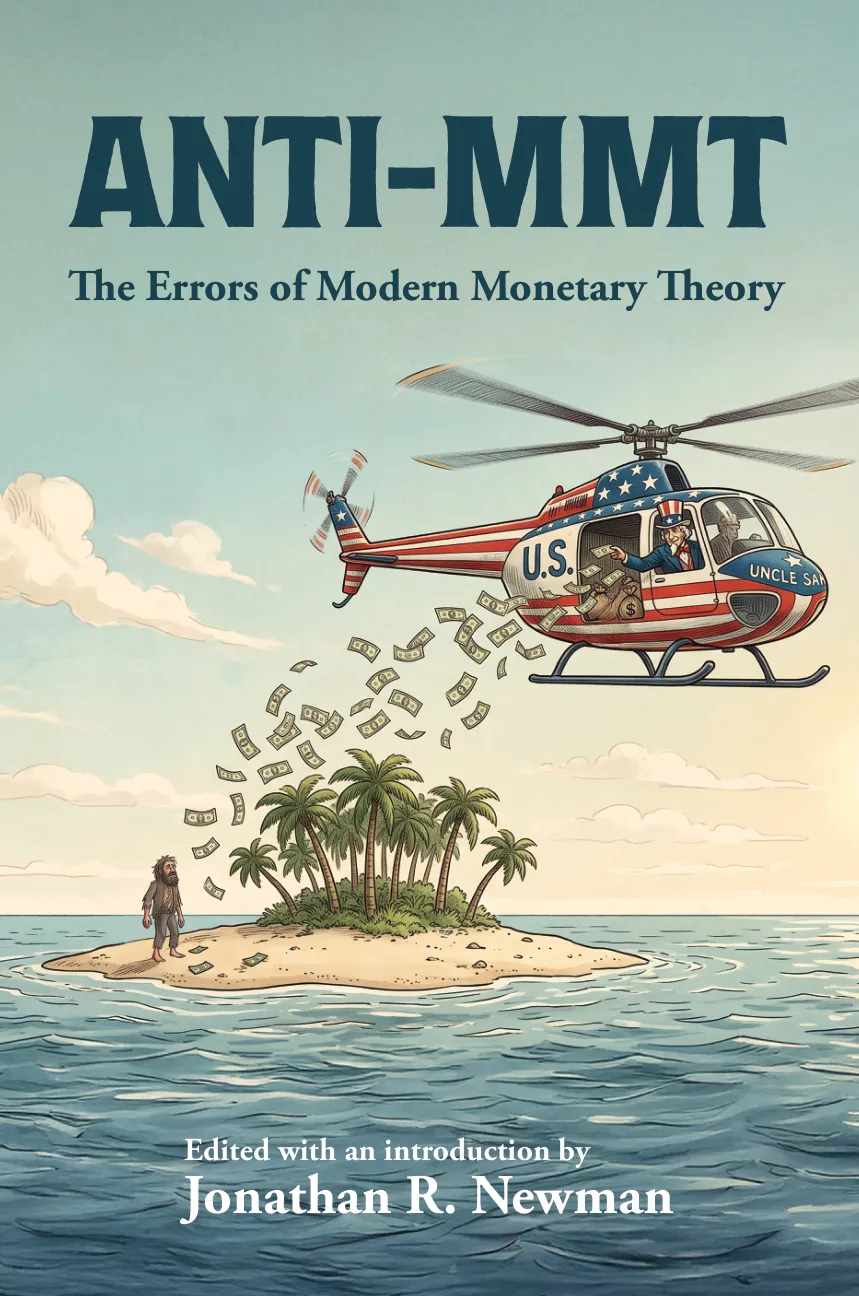
Anti-MMTThe Errors of Modern Monetary Theory
Edited with an introduction by Jonathan R. Newman
Purchase link coming soon
Money is not the same thing as wealth.

Beyond the printing press
Real resources.Productive capital.Market prices.
Modern Monetary Theory argues that governments issuing their own currency face a real-resource constraint, rather than the financial constraint of a household. But does that mean the government should play a larger role?
Anti-MMT brings the Austrian tradition to bear on the debate. From the origins of money to inflation, public debt, and job guarantees, its contributors examine what MMT leaves out—and why those omissions matter.
The questions behind the debate
Inside Anti-MMT
Explore the arguments, chapter by chapter.
Each essay takes on a different aspect of the MMT framework.
EIGHT PERSPECTIVES. ONE ESSENTIAL DEBATE.
CHAPTER 01STARTS ON PAGE 17
Newman challenges the state theory of money, drawing on Carl Menger’s theory of the origins of money and evidence from ancient Mesopotamia.
Jonathan R. Newman

CHAPTER 02STARTS ON PAGE 41
Salerno traces the development of monetary theory and argues that MMT separates money and spending from the individual valuations that shape market prices.
Joseph T. Salerno

CHAPTER 03STARTS ON PAGE 67
Murphy examines sectoral balances and challenges the claim that government debt represents private-sector wealth. Accounting identities, he argues, cannot substitute for economic analysis.
Robert P. Murphy

CHAPTER 04STARTS ON PAGE 91
Newman explores how inflation-financed government spending redirects resources and distorts the structure of production, investment, and economic growth.
Patrick Newman

CHAPTER 05STARTS ON PAGE 117
Israel questions whether aggregate price measures can provide policymakers with the information needed to manage inflation and identify the economy’s resource constraints.
Karl-Friedrich Israel

CHAPTER 06STARTS ON PAGE 141
Bylund brings scarcity, human action, and economic calculation into focus, examining the difference between money creation and entrepreneurship.
Per L. Bylund

CHAPTER 07STARTS ON PAGE 165
Mawhorter argues that MMT proponents take “monetary sovereignty” for granted—their policies undermine their own preconditions.
Joshua A. Mawhorter

CHAPTER 08STARTS ON PAGE 189
Engelhardt scrutinizes the case for a government job guarantee, asking whether it would accomplish what MMTers say it would.
Lucas M. Engelhardt
From Jonathan Newman’s introduction
“MMT is essentially a set of accounting tautologies used in misleading ways to promote progressive political goals.”
Watch & listen
Henry Hazlitt Research Fellow · Mises Institute
Bringing the Austrian perspective to one of today’s most consequential monetary debates.
Dr. Newman’s research focuses on Austrian economics, inflation, business cycles, and the history of economic thought. In addition to editing this volume and writing its introduction, he contributes the opening chapter on the origins of money.
He received the 2025 Lawrence W. Fertig Prize in Austrian Economics and the Rothbard Prize at the 2025 Madrid Conference on Austrian Economics for the research on the origins of money published in this book.
Get the book
Explore the full Austrian critique of Modern Monetary Theory in Anti-MMT.
Purchase link coming soon